~18 min read · Updated
The Autonomous Enterprise
Strategic Deployment of AI Agents for Digital Marketing, SEO, and Operational Scale in Small Businesses
Access the Playbook
From Calculators to Co-Founders. Learn how agentic AI is transforming digital marketing for independent founders.
Initialize Agentic Protocol- The shift from tools to agents: Why AI in 2026 operates like a tireless co-founder, not a calculator.
- The three platforms: OpenClaw (24/7 autonomous), Claude Cowork (desktop-integrated), Perplexity Computer (cloud-scale) — and when to use each.
- Programmatic SEO at scale: How AI agent pipelines research, write, and deploy dozens of pages per week automatically.
- Social media on autopilot: Content repurposing, DM lead qualification, and competitor monitoring without burning out.
- The economics: Why a $20/month VPS can replace $5,000/month in agency fees.
- How to start: A 6-step guide to launching your first OpenClaw agent system today.
The Paradigm Shift: From Calculators to Co-Founders
Autonomous AI marketing is the deployment of persistent, goal-oriented AI agents that can perceive their digital environment, formulate multi-step plans, use external tools via APIs, and execute marketing campaigns and SEO strategies with minimal human intervention. Unlike tools that require constant prompting, autonomous agents run continuously and self-direct toward defined business goals.
If you are an independent small business owner, a technical founder, or a solopreneur, you know the feeling of exhaustion. You are wearing twelve different hats, expected to instantly respond to customer inquiries, maintain a flawless social media presence, write brilliant SEO content, and somehow still find time to build your actual product. For years, the digital marketing landscape demanded that you operate like a Fortune 500 enterprise, but with a fraction of the budget and manpower.
In early 2026, the rules of the game changed entirely. We shifted from passive artificial intelligence to agentic autonomy.
Autonomous AI Marketing refers to the deployment of persistent, goal-oriented artificial intelligence agents that can perceive their digital environment, formulate complex multi-step execution plans, leverage external tools via APIs, and evaluate their own performance to autonomously execute marketing campaigns, SEO strategies, and social media engagement with minimal human intervention.
Think of it this way: the old AI tools (like standard ChatGPT or basic copy generators) were like highly advanced calculators. They were incredibly smart, but they just sat there on your desk. You had to punch in the exact numbers (prompts) every single time to get an answer. If you stopped pressing buttons, the calculator stopped working.
Autonomous AI agents are entirely different. They are not calculators; they are like hiring a tireless, brilliant intern or co-founder who never sleeps. These digital workers can perceive their environment, form complex multi-step plans, use external tools (like opening a web browser or clicking through a spreadsheet), and evaluate their own work without you having to hold their hand.
By April 2026, the tech world officially woke up to the fact that autonomous platforms—like OpenClaw, Google’s Antigravity, and Anthropic’s Claude Cowork—were no longer just science experiments. They were actively running real businesses, managing corporate inboxes, writing code, and driving sales. For a small business, this means you can finally scale your digital presence, execute massive programmatic SEO campaigns, and manage thousands of personalized social media messages without having to hire a massive team.
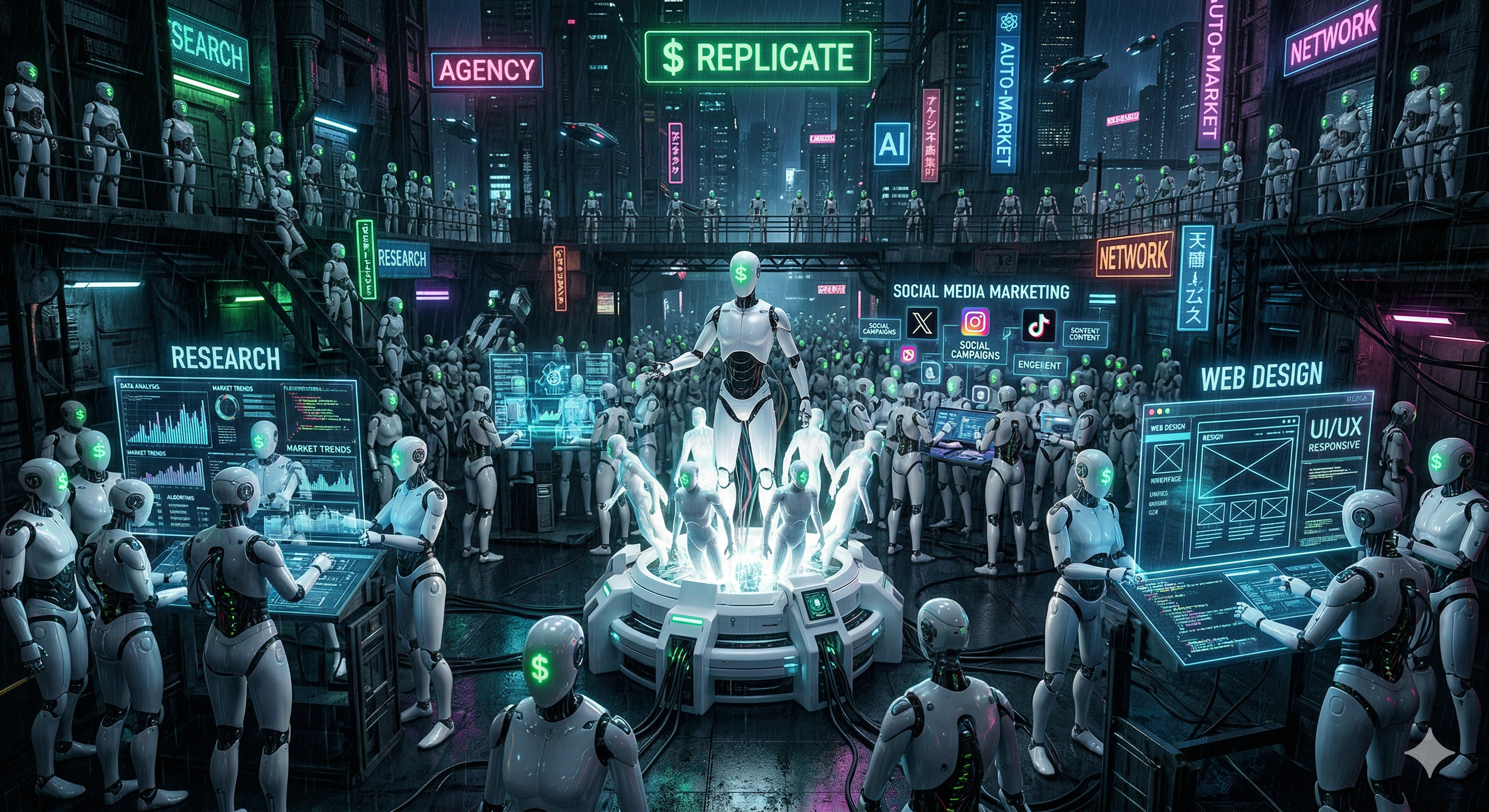
Core Architectural Frameworks: Building Your Digital Dream Team
AI marketing agents run in three main environments: on local hardware (your own dedicated machine like a Mac Mini M4), on a cloud VPS (a rented virtual server at $5–20/month), or fully managed in the cloud via platforms like Perplexity Computer. The choice affects cost, privacy, uptime, and technical setup requirements.
To understand how you can automate your marketing, you first need to know where these digital workers “live.” Right now, solopreneurs are building their AI teams across three main environments: your local machine, your desktop workspace, and the cloud.
OpenClaw: The “Ocean’s Eleven” Crew
Imagine putting together a heist crew where everyone has a hyper-specific job. OpenClaw is a free, open-source framework that lets you do exactly that for your business. Because these agents need to be online 24/7, you usually run them on dedicated hardware like a Mac Mini M4 or a VPS.
Founders create “AI CMOs” and “AI CTOs” that communicate via session_visibility: all. Your AI CMO can research a trend and hand the strategy to your AI CTO to build a landing page. Security protocols like NVIDIA NemoClaw keep your digital team in check.
Claude Cowork: The Desktop Assistant
Claude Cowork is the ultimate executive assistant living inside your Mac or Windows computer. It operates using “Projects” — dedicated offices for specific marketing campaigns. Cowork can turn messy voice memos and PDFs into research reports or Excel calendars autonomously.
With a Pro subscription, you can even text your desktop agent from your phone while at the grocery store to start a task before you get home. No server management required.
Perplexity Computer: The Cloud Octopus
Perplexity Computer is like a digital octopus living in the cloud. It uses massive server farms to run dozens of workflows simultaneously using multi-model orchestration — hiring the best “specialist” for each piece: Gemini for research, GPT-5.2 for web scouring, Claude Opus for logic.
Every task happens in a secure, isolated bubble with a real browser, allowing the AI to navigate websites exactly like a human would.
OpenClaw vs. Claude Cowork vs. Perplexity Computer: Which Is Right for You?
OpenClaw is best for solopreneurs who want 24/7 autonomous background workflows with full infrastructure control. Claude Cowork is best for task-driven desktop work and organized campaign management. Perplexity Computer is best for scaling workflows in the cloud without managing your own servers.
| Feature | OpenClaw | Claude Cowork | Perplexity Computer |
|---|---|---|---|
| Hosting | Your hardware / VPS (self-managed) | Desktop app (Mac or Windows) | Cloud-managed (no setup) |
| Setup complexity | High — requires configuration, API keys, environment setup | Low — install app, create a Project | Very low — web-based, instant start |
| Cost | API token fees only ($5–20/mo VPS or one-time hardware) | Claude Pro subscription (~$20/mo) | Usage-based cloud pricing |
| Runs 24/7 autonomously | Yes — fully persistent background agents | No — requires computer on and user active | Yes — cloud-based, always on |
| Multi-agent support | Yes — agents share context via session_visibility: all |
Via Projects (human-directed handoffs) | Yes — multi-model orchestration |
| SKILL.md / custom skills | Full support — inject any skill file | Via system prompts in Projects | Limited — platform manages models |
| Data privacy | Highest — data stays on your hardware | Medium — processed by Anthropic | Lower — fully cloud-managed |
| Best for | Solopreneurs wanting full autonomy and infrastructure control | Day-to-day desktop tasks and organized campaign work | Scaling workflows without infrastructure overhead |
| Verdict | Best for autonomous 24/7 marketing pipelines | Best for productivity and daily operations | Best for cloud-scale without self-hosting |
Super-Skills: Downloading Kung-Fu into Your AI
A SKILL.md file is a plain text document that injects specialized domain expertise into an AI agent’s context window — like downloading expert knowledge directly into the agent’s brain. A Marketing SKILL.md gives your agent best practices for competitive analysis, brand voice, and SEO in seconds, replacing an entire operations manual. These files are shared openly in the AI community and can be stacked.
In the movie The Matrix, Neo says, “I know Kung Fu” after downloading a skill directly into his brain. That is exactly what “Super-Skills” do for your AI agents. Thanks to the open-source community, you can download a simple text file (a SKILL.md file) and drop it into your agent’s context. Suddenly, your generic AI becomes a senior-level marketing expert — with best practices for competitive analysis, brand voice adherence, and SEO optimization baked in.
How to Get Started with OpenClaw: A 6-Step Quick-Start Guide
Setting up OpenClaw involves choosing a hosting environment (local Mac Mini or cloud VPS), installing the framework with API keys, configuring agent roles, loading SKILL.md files, and setting up a Telegram-based Human-In-The-Loop approval channel. Most solopreneurs are operational within 1–2 hours.
OpenClaw’s reputation for complexity puts off many solopreneurs — but the core setup is more approachable than it looks. Here’s the sequence that gets you from zero to a running autonomous agent system:
-
Choose your hosting environment
Decide between local hardware (Mac Mini M4, ~$600 one-time — best for privacy and data sovereignty) or a cloud VPS ($5–20/month on Hetzner or DigitalOcean — best for always-on reliability). For most solopreneurs starting out, a $10/month VPS is the pragmatic first step before committing to hardware.
-
Install OpenClaw and configure your API keys
Clone the OpenClaw repository from GitHub, install the Node.js dependencies, and add your AI provider API keys to the environment variables file. Anthropic (Claude), Google (Gemini), and OpenAI are all supported. For high-volume background tasks,
gemini-2.5-flashoffers the best reliability-to-cost ratio at scale. -
Define your agent roles
Create configuration files assigning specific roles: an AI CMO for research, strategy, and competitive analysis, and a Content Agent for writing and publishing. Set
session_visibility: allso agents share a common context and can hand off tasks without losing information between them. -
Install your SKILL.md files
Download relevant SKILL.md files from the open-source community. The core four for most solopreneurs: Marketing, SEO, Social Media, and Brand Voice. Place them in your agent’s skills directory. They inject specialized expertise instantly — no lengthy system prompts to write from scratch.
-
Configure your HITL approval queues
Set up Human-In-The-Loop workflows before going live: Queue A for auto-approved busywork (data aggregation, internal reporting), Queue B for content drafts requiring a quick read-through, and Queue C for high-risk customer-facing actions that need your explicit sign-off before execution.
-
Launch and monitor via Telegram
Start your agents and configure Telegram as your notification and approval hub. Agents execute autonomously in the background and ping you on Telegram only when Queue B or C review is needed. You can approve, reject, or redirect from your phone in seconds — from anywhere in the world.
Don’t try to launch a full multi-agent system on day one. Begin with a single content agent running one workflow — daily competitor monitoring plus a weekly blog post draft. Run it for two weeks, refine the prompts, then expand. Complexity compounds quickly; mastering one workflow before adding the next is how you build a system that actually runs reliably.
Revolutionizing Search Engine Optimization (SEO)
AI agents automate every stage of the SEO pipeline: keyword research, content drafting, on-page optimization, internal linking, publishing to WordPress via REST API, and performance monitoring through Google Search Console feedback loops. A two-agent pipeline (research agent + publishing agent) can produce and deploy dozens of optimized pages per week without human involvement in each step.
For years, SEO felt like building a massive neighborhood one brick at a time. You had to research the keyword, write the draft, optimize tags, build links, and publish — manually, every time. AI agents have turned SEO into an automated real-estate development firm.
Programmatic SEO: Building at Scale
Programmatic SEO with AI agents means using autonomous systems to research, create, optimize, and publish large volumes of targeted content pages automatically. An AI CMO identifies 50 niche keyword opportunities, hands the strategy to an AI CTO, who writes the code using frameworks like Astro or Next.js, pushes to GitHub, and deploys via Vercel — all while you eat lunch.
Imagine identifying 50 different niche audiences for your product (e.g., “Software for Plumbers in Ohio”). Building 50 unique pages manually would take weeks. With OpenClaw, your AI CMO does the research and hands it to the AI CTO, who writes and deploys the code automatically. You can publish dozens of targeted landing pages while you eat lunch.
The SEO Content Pyramid
Smart agents follow the SEO Content Pyramid to ensure your content actually generates revenue, not just traffic. The AI allocates its energy across three layers:
| Content Pyramid Layer | Primary Goal | User Intent | Types of Content Generated by AI Agents |
|---|---|---|---|
| Convert Content (Top — 20%) | Drive immediate sales | Ready to buy, comparing solutions | Competitor comparisons (“Tool A vs Tool B”), deep product reviews, buyer guides, optimized product landing pages. |
| Discover Content (Middle — 40%) | Evaluate market solutions | Exploring options for recognized problems | Problem-solving articles, case studies, data-heavy statistical reports, downloadable templates. |
| Awareness Content (Bottom — 40%) | Educate and attract | Early research, top-of-funnel | High-level definitions, educational guides, industry trend analysis, curated lists. |
Backlinks: The High-Society Networking Event
Getting backlinks used to involve sending hundreds of spammy cold emails. Today, AI agents handle this like a sophisticated matchmaker. Solopreneurs run 4-agent pipelines: one audits for gaps, one writes content, one publishes gradually, and the fourth — the Backlink Agent — uses semantic matching to identify and approach only highly relevant link partners. Triangle link structures (Site A → B → C → A) distribute authority without triggering Google’s pattern detection.
Will Google Punish Me? The “Robot Baker” Analogy
No. Google’s SpamBrain penalizes low-quality, unedited, search-engine-first content — not AI authorship. If your AI content incorporates genuine expertise, unique proprietary data, and strong E-E-A-T signals (Experience, Expertise, Authoritativeness, Trustworthiness), it ranks identically to human-written content. The risk is laziness in your prompts, not automation itself.
Google doesn’t care if a robot or a human baked the cake; they only care if the cake is delicious and helpful. There is no blanket “AI penalty.” If you inject your unique brand stories, proprietary data, and true expertise into the AI’s prompt, you will win. As AI search engines mature, they increasingly reward freshly updated content — and agents can automatically refresh old blog posts so you stay visible in AI Overviews and traditional SERPs alike.
Social Media: Your 24/7 Digital Sales Rep
AI agents automate the full social media pipeline: repurposing long-form content (videos, podcasts) into platform-specific posts, scheduling via tools like Postiz, monitoring competitors overnight, and handling DM lead qualification at scale. A single agent can manage 500 DMs per day in your brand voice, qualify leads, and only escalate the highest-intent prospects to you.
An autonomous AI agent acts like a proactive community manager and content director rolled into one — running 24 hours a day without ever burning out.
The Content Repurposing Machine
Feed an AI agent a single 45-minute YouTube video and it will autonomously turn it into a month of content. It chunks the transcript, extracts quotes, writes LinkedIn posts, Twitter threads, and TikTok scripts. It then reaches out to APIs like ElevenLabs for voice or video generation tools for thumbnails, and schedules everything via platforms like Postiz — your entire content calendar, automated.
Direct Messages: Where the Money is Made
People don’t buy in comments; they buy in the DMs. AI-driven SDRs using ManyChat, Visito, or SetSmart can handle 500 DMs a day. When someone comments “Send me the link,” the AI slides into their DMs, qualifies them as a lead, and answers questions in your brand’s voice — before passing only the hottest prospects to you for close.
| Instagram Automation Tool | Primary Strength / Best Use Case | AI Integration Level |
|---|---|---|
| Visito | Balanced sales and support automation without complexity. | Mid-tier AI assistance |
| ManyChat | Creators running robust comment-to-DM funnels. | Flow-based + basic AI |
| SetSmart | Advanced AI lead qualification and automated call booking. | GPT-powered |
| Respond.io | Larger teams requiring shared inboxes and AI routing. | Advanced AI routing |
| Jotform Agent | Capturing structured lead data inside the chat interface. | Form-integrated AI |
| Chatfuel | Fast deployment for multi-channel Meta automation. | Flow-based |
The “8:00 AM Competitor Monitor”
While you sleep, cloud orchestrators scan competitors’ pricing pages, read product update announcements, and monitor social media for customer complaints. Every morning, a concise intelligence briefing lands in your Slack — allowing you to pivot strategy faster than a 500-person enterprise ever could.
The Economics: Rent, Own, or Hire?
A local Mac Mini M4 setup costs $500–640 one-time plus API token fees. A cloud VPS costs $5–20/month plus API fees. Both options replace marketing functions that would cost $3,000–10,000/month in agency fees or in-house staff. Most solopreneurs achieve positive ROI within 30–90 days of deployment.
| Infrastructure Type | Estimated Hardware / Hosting Cost | Ongoing Operational Cost | Ideal User Profile |
|---|---|---|---|
| Local Hardware (Mac Mini M4) | $500 – $640 (one-time) | API token fees only | Privacy-conscious solopreneurs; maximum data sovereignty. |
| VPS — Entry/Mid Tier | $5 – $20 / month | API token fees | Small teams, always-on workflows, no hardware commitment. |
| Custom Enterprise Build | $40,000 – $200,000+ | $10k–$50k/yr maintenance | Fully tailored multi-agent logic with CRM integration. |
If an LLM “hallucinates,” the consequences for a small business can be catastrophic — offering 90% discounts to 1,000 people or leaking customer data. Smart founders use the Human-In-The-Loop (HITL) strategy to manage this risk.
Think of the AI as your sous-chef. It preps and plates, but you — the executive chef — taste the dish before it leaves the kitchen. Structure workflows into Queue A (Auto-Approve) for low-risk busywork, Queue B (Quick Review) for content drafts, and Queue C (Human Required) for high-stakes customer interactions.
Embracing the Autonomous Future
The shift to autonomous AI marketing is an incredible equalizer. It gives the solo founder the operational firepower of a massive agency — allowing you to scale your programmatic SEO, dominate social media outreach, and monitor competitors continuously without burning out or breaking the bank.
Building these systems from scratch requires navigating a maze of API tokens, hardware configurations, and agent orchestration logic. Try to do it alone and you can waste months and thousands of dollars. Hire an enterprise firm and you’ll spend $40,000 before a single line of production code is written.
This is exactly why our autonomous marketing setup package is the perfect starting point. We provide pre-engineered SKILL.md files, proven agent architectures, and plug-and-play HITL workflows — so you can skip the frustration and deploy your tireless digital dream team today.

About James Jernigan
James Jernigan is an independent AI automation researcher, solopreneur, and digital marketer operating jamesjernigan.com, how2rank.com, and profitpassively.com. He specializes in AI-driven SEO, agentic workflow architecture, and OpenClaw-based client deployments across the affiliate marketing, programmatic SEO, and AI automation niches.
James is a published security disclosure author, having been the first independent researcher to document and responsibly disclose to Reddit’s security team the existence of an AI-powered autonomous social media manipulation system built using only free tools — research that was shared across the tech security community in 2025.
Sources & Further Reading
- Google Google Search Essentials: Creating Helpful, Reliable, People-First Content — Official stance on AI content, E-E-A-T, and spam policies.
- Anthropic Claude Documentation — Agents, Tool Use & Agentic Workflows — Technical reference for Claude API, multi-step agents, and agentic system design.
- Semrush AI Overviews Research: Analysis of 10M+ Keywords — Data on Google AI Overview trigger rates by industry, query type, and CTR impact.
- Ahrefs Impact of Google AI Overviews on Organic CTR — 300,000 Keyword Study — Research on the 58% CTR drop when AI Overviews are present at position one.
- Schema.org FAQPage Schema Specification — Structured data format for FAQ content eligible for Google AI Overviews and rich results.
- Frase.io The Complete AEO Guide: How to Get Cited by AI Search Engines — Comprehensive breakdown of answer engine optimization strategies for ChatGPT, Perplexity, and Gemini.
- llmstxt.org llms.txt Specification — AI-Friendly Site Navigation Standard — The proposed standard for helping AI crawlers navigate website content at inference time.